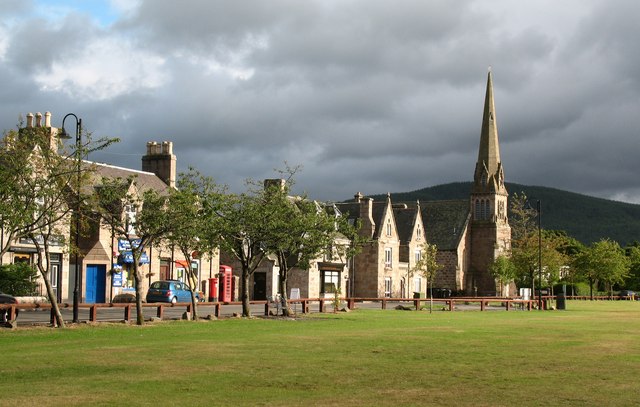
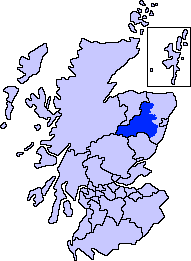
Aboyne (Scots: Abyne, Scottish Gaelic: Abèidh) is a village on the edge of the Highlands in Aberdeenshire, Scotland, on the River Dee, approximately 30 miles (48 km) west of Aberdeen. It has a swimming pool at Aboyne Academy, all-weather tennis courts, a bowling green and is home to the oldest 18 hole golf course on Royal Deeside. Aboyne Castle and the Loch of Aboyne are nearby. Aboyne has many businesses, including a Co-Op supermarket, several hairdressers, a butcher, a newsagent, an Indian restaurant and a post office. Originally, there was a railway station in the village, but it was closed on 18 June 1966. The station now contains some shops and the tunnel running under the village is now home to a firearms club. The market-day in Aboyne was known as Fèill Mhìcheil (Scottish Gaelic for "Michael's Fair").
Timeline
Photos


Full History
The name "Aboyne" is derived from "Oboyne", first recorded in 1260, in turn derived from the Gaelic words "abh", "bo", and "fionn", meaning "[place by] white cow river". The village of Aboyne was founded by Charles Gordon, 1st Earl of Aboyne in 1671, who, in the same year, rebuilt the west wing of Aboyne Castle. The siting of the castle itself is related to the limited number of the crossings of the Mounth of the Grampian Mountains to the south. In 1715 Aboyne was the scene of a tinchal, or great hunt, organised by John Erskine, sixth Earl of Mar, on 3 September, as a cover for the gathering of Jacobite nobles and lairds to discuss a planned Jacobite rising. The uprising began three days later in Braemar. The former Aboyne Public School was used as a secondary school to the local area, but was notably used during WWII as an evacuee station for those coming from Glasgow. Local Aboyne children were educated in the morning and the evacuee children were educated in the afternoon. Any overflow evacuees were passed on to the nearby church hall, and as many as 1,250 were evacuated to the Deeside area in 1939.
Source: Wikipedia