Amesbury () is a town and civil parish in Wiltshire, England. It is known for the prehistoric monument of Stonehenge which is within the parish. The town is claimed to be the oldest occupied settlement in Great Britain, having been first settled around 8820 BC. The parish includes the hamlets of Ratfyn and West Amesbury, and part of Boscombe Down military airfield.
Timeline
Photos


Full History
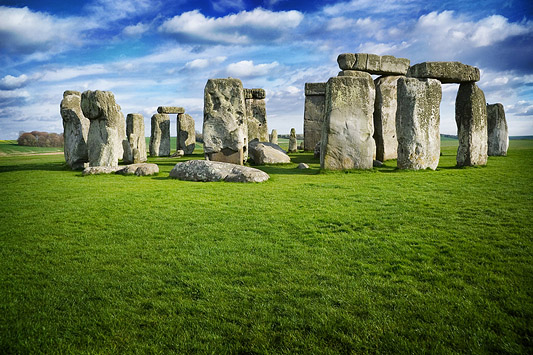
The land around Amesbury has been settled since prehistoric times, evidenced by the monument of Stonehenge. In 2014, archaeologists from the University of Buckingham found Amesbury had been continually occupied since 8,820BC, causing The Guardian to write that Amesbury was "in effect where British history began". Other finds in the parish point to large-scale prehistoric structures and settlements in the area, including Bluestonehenge at West Amesbury, the numerous other monuments around Stonehenge, and the discovery of a Neolithic village in the neighbouring parish of Durrington by the Stonehenge Riverside Project. Excavations in 2002 and 2003 at Boscombe Down by Wessex Archaeology found the Amesbury Archer and Boscombe Bowmen. It is likely that there was a large Romano-British settlement overlooking the River Avon at this point. It is possible that an order of monks established a monastery in the area, that was destroyed by the Saxons before they settled the area in the 7th century. King Alfred the Great left Amesbury in his will, a copy of which is in the British Library, to his youngest son Aethelweard (–922). In 1086, Domesday Book recorded a settlement named Amblesberie or Ambresberie with 111 households and eight mills. The largest estate was held by Wilton Abbey, and other land was held by Edward of Salisbury. In 979 AD, a Benedictine abbey, the Abbey of St Mary and St Melor, was founded on what may have been the site of a previous monastery, by Dowager Queen Ælfthryth. In 1177 the abbey was dissolved by Henry II Henry III visited the priory several times, and his widow Eleanor of Provence retired there in 1286, leading to visits by her son, Edward I; his daughter Mary of Woodstock and niece Eleanor of Brittany had already entered the convent when young. The priory continued until the dissolution of the monasteries in 1540, after which its buildings – including the church with its lead-covered spire – were demolished. The estate remained in the Queensberry family until 1824. It is believed that at some point in the early 19th century, William Douglas, 4th Duke of Queensberry planted the Nile Clumps to commemorate Admiral Nelson, and had the hillfort landscaped as part of the grounds around the mansion. In 1824, Sir Edmund Antrobus acquired the estate and, finding the mansion in poor repair, had it rebuilt in 1834–1840 to designs of Thomas Hopper. The house is now operated as a nursing home. In 1677, John Rose, gentleman, founded two schools at Amesbury, a grammar school for teaching grammar, writing, and ciphering to twenty children born in the parish, and an "English school" to prepare twenty children of poor parents for the grammar school. By a decree in Chancery of 1831, the freedom of the grammar school was extended to children of "mechanics, artisans, and small tradesmen". The grammar school was closed in 1899, and the children were transferred to a National School. With the establishment of the military Aeroplane and Armament Experimental Establishment at Boscombe Down in 1939, Amesbury began to expand. As it lies within the A303 commuter belt, Amesbury has seen substantial developments on the land between the old town centre and Boscombe Down. Several new housing estates have been completed, and the most recent one – Archers Gate – has taken its name from the discovery of the Amesbury Archer. At the Boscombe Down junction of the A303, a mixed business development known as Solstice Park has been built. On 30 June 2018, two British nationals were poisoned using Novichok nerve agents before being found unconscious at a property in Amesbury; one of them, Dawn Sturgess, later died. Almost four months earlier, the same nerve agents were used in the poisoning of Sergei and Yulia Skripal in nearby Salisbury. The Amesbury property was later demolished.
Source: Wikipedia