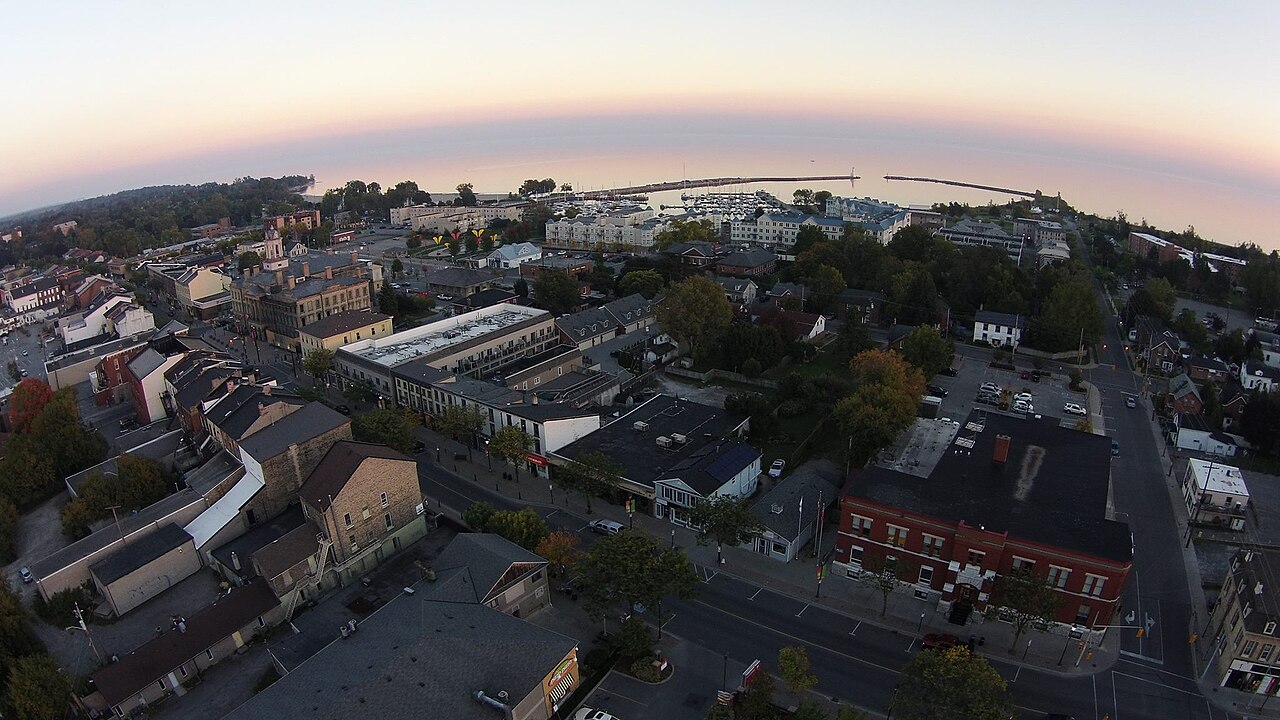
Cobourg ( KOH-burg) is a town in the Canadian province of Ontario, located in Southern Ontario 95 km (59 mi) east of Toronto and 62 km (39 mi) east of Oshawa. It is the largest town in and seat of Northumberland County. Its nearest neighbour is Port Hope, 7 km (4 mi) to the west. It is located along Highway 401 (exits 472 and 474) and the former Highway 2 (now Northumberland County Road 2). To the south, Cobourg borders Lake Ontario. To the north, east and west, it is surrounded by Hamilton Township.
Bell Homestead National Historic Site
Alexander Graham Bell made the world's first long-distance telephone call from his father's homestead in Tutela Heights, just minutes from West Brant. The Bell Homestead National Historic Site preserves the farmhouse and coach house where Bell conducted his early telephone experiments in the 1870s. Open seasonally for tours.
Timeline
Notable People
Photos



Full History
The land which present-day Cobourg occupies was previously inhabited by Mississauga (Anishinaabemowin-speaking) peoples. The settlements that make up today's Cobourg were founded by United Empire Loyalists in 1798 within Northumberland County, Home District, Province of Upper Canada. Some of the founding fathers and early settlers were Eliud Nickerson, Joseph Ash, Zacheus Burnham and Asa Allworth Burnham. The Town was originally a group of smaller villages such as Amherst and Hardscrabble, which were later named Hamilton. In 1808 it became the district town for the Newcastle District. It was renamed Cobourg in 1819, in recognition of the marriage of Princess Charlotte Augusta of Wales to Prince Leopold of Saxe-Coburg-Saalfeld (later Saxe-Coburg and Gotha, who would later become King of Belgium). By the 1830s, Cobourg had become a regional centre, mostly due to its fine harbour on Lake Ontario. In 1835 the Upper Canada Academy was established in Cobourg by Egerton Ryerson and the Wesleyan Conference of Bishops. On 1 July 1837, Cobourg was officially incorporated as a town. In 1841 the Upper Canada Academy's name was changed to Victoria College. In 1842 Victoria College was granted powers to confer degrees. This meant goods and passengers could be brought at least to the south shore of Rice Lake. The remaining 8 miles of rough tracks was viable for passengers and light goods, but no use for the valuable timber and mine products. By 1835, only 10 years after the first steam railway in the world, there was active discussion about building a railway up to what later became Harwood. However, the townspeople invested instead in a plank road, using 300,000 feet of 3-inch wooden planks, allowing horse-drawn vehicles to haul heavy goods. By 1850 the plank road was breaking up, and was impassible in wet conditions, so the railway scheme was revived. By 1852, there was considerable enthusiasm for the railway project within the town. River traffic had become seen as yesterday's solution by this time, so the plans were expanded to include a long bridge across Rice Lake, to take the railway right up to Peterborough. By 1854 the rails reached the shore of the lake, and it found good work transporting passengers and nearly 2 million feet of lumber from the Rice Lake down to Cobourg that summer. However, revenue from the project had to be diverted into building an ill-fated bridge, using hundreds of wooden trestles, 31 Burr Truss spans, and a centre-pivot swing bridge to allow boats to pass. The prime mover locally for getting the Railway company off the ground was D'Arcy E. Boulton, a lawyer based in Cobourg, who enthused the town with the plan. They agreed to begin funding the scheme that was initially expected to cost £150,000, but ended leaving many people with worthless railway bonds and the town council with a debt that was only finally repaid in the 1930s. The man appointed to manage the project was Samuel Zimmerman, who had previously been instrumental in building the Great Western Railway (Ontario). The bridge was constructed over the summer of 1854 and was officially opened on 29 December that year. Three days later, it collapsed when ice movements shifted the trestles out of line, splintering the Burr Truss sections. The proposed solution was to stabilise the trestles (or 'stilts' as their critics dubbed them) by an infill of soil, which did happen on the southern side, still visible as a strip of land still remaining running into the lake near Harwood. But funds were not forthcoming for the northern side, and winter ice and shifting lake mud meant that it was frequently unusable. A further problem emerged when Port Hope, not far along the coast, pursued its own plans for a railway to Peterborough. In 1857, the Port Hope and Lindsay line was constructed, and the following year opened a branch to Peterborough, going round the western end of the lake, in direct competition with the struggling Cobourg route. The response of the Cobourg directors was to oust D.E. Boulton, who then invested in the Port Hope line. Conflicts of interest among various personnel resulted in the deliberate removal of the bolts on sections of the bridge in early 1861, ensuring that when the ice moved again the bridge was destroyed, and this time it was left unrepaired. The railway reverted to linking Cobourg harbour with Harwood and the Rice Lake water traffic. In 1865, the railway was bought by a consortium of Pittsburgh steel manufacturers, who had already bought the Marmora Iron quarries north-east of Rice Lake. They established an iron-ore supply route using barges up the Trent River and across Rice Lake to the railway at Harwood. From there it was brought along the Railway to Cobourg Harbour for shipment across Lake Ontario to feed the steel mills of America. This provided a steady income for the railway and the town until the ore ran out in 1878. It also had two longer term spin-offs in the form of a rail car company and the beginnings of a tourist industry. When the iron ore scheme was getting underway, a small iron foundry based in Cobourg, was approached to cast the wheels and frames of wagons to move the Marmora iron ore down to the harbour. James Crossen saw an opportunity to combine his cast-iron products with the abundant local timber to produce railway rolling stock. With the foundry located near both the Cobourg line and train station of the Grand Trunk Railway, which had been built along the shore of Lake Ontario in 1856, it was well placed to expand as Canada's railway network grew. It was later named the Crossen Car Manufacturing Company and went on to become the largest builder of timber-framed rail cars in Canada, making everything from coal and freight wagons through to dining cars and first-class carriages. By 1910, wood was going out of date, when all-steel cars took over, and in 1915 the company, unable to adapt, went into liquidation, and parts of the site reverted to being an iron foundry. A replica of one of the Crossen ore cars was built in 2016 and is on display near Cobourg waterfront. The connections and trade links which developed through the iron shipments brought many American industrialists to Cobourg, which became a popular summer destination. Victoria Hall stands at the heart of the downtown, a building that now serves as the town hall, as well as home of the Art Gallery of Northumberland, the Cobourg Concert Hall, and an Old Bailey-style courtroom that is now used as the Council chamber. Victoria Hall was designed by architect Kivas Tully. The landmark is known for its impressive stone work. Charles Thomas Thomas (1820-1867), an English-born master stonecarver and building contractor, executed the fine stone carvings, including the bearded faced keystone over the main entrance into the building. Victoria Hall was officially opened on September 6, 1860 by the Prince of Wales, later to become King Edward VII. At that time, Cobourg was a significant town in the Province of Canada, and some townspeople felt that Cobourg would be a suitable capital for the newly united provinces; this privilege went to Ottawa, Ontario, however. One of the oldest buildings in the town was for many years known as The Barracks, suggesting military connections. However it is equally likely that it was built for industrial uses, either in the very early 1800s or as a malting house and brewery by James Calcutt in the early 1830s. It probably served that purpose until a larger brewery was built by the McKechnies in 1863. The old stone-built building had a variety of industrial and storage purposes, and twenty different owners. In 2000 it was acquired in a run-down state by the Cobourg Museum Foundation, who have restored it and it is now open as the Sifton-Cook Heritage Centre. In 1906 on 77 Albert Street the Cobourg Jail, originally referred to as The County Jail, began to house inmates.
Source: Wikipedia