Kamloops ( KAM-loops) is a city in south-central British Columbia, Canada, at the confluence of the North and South Thompson Rivers, which join to become the Thompson River in Kamloops, and east of Kamloops Lake. The city is a commercial centre for, and largest city within, Thompson Country, a region of the British Columbia Interior. The city was incorporated in 1893 with about 500 residents. The Canadian Pacific Railway was completed through downtown in 1886, and the Canadian National arrived in 1912, making Kamloops an important transportation hub. Kamloops North station is the first stop on VIA Rail's eastbound transcontinental service, The Canadian, while the Rocky Mountaineer and the Kamloops Heritage Railway both use Kamloops station. With a 2025 population of 109,633, it is the twelfth largest municipality in the province. The Kamloops census agglomeration is ranked 36th among census metropolitan areas and agglomerations in Canada with a 2025 population of 127,198. Kamloops is home to Thompson Rivers University as well as the Royal Inland Hospital and the British Columbia Lottery Corporation, all of which significantly shape the city's economy.
Bell Homestead National Historic Site
Alexander Graham Bell made the world's first long-distance telephone call from his father's homestead in Tutela Heights, just minutes from West Brant. The Bell Homestead National Historic Site preserves the farmhouse and coach house where Bell conducted his early telephone experiments in the 1870s. Open seasonally for tours.
Timeline
Photos



Full History
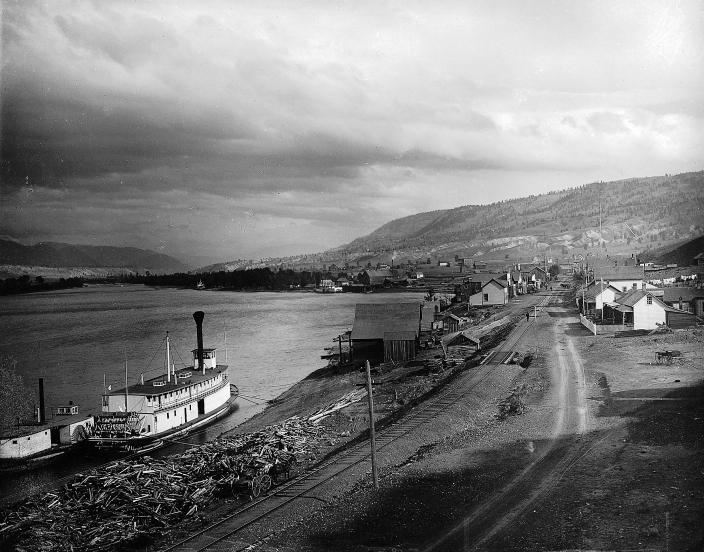
The first European explorers arrived in 1811. David Stuart, a trader sent from Fort Astoria, then still a Pacific Fur Company post, spent a winter with the Secwépemc people. In May of the following year, trader Alexander Ross established a post, which was known as "Fort Cumcloups". The rival North West Company established Fort Shuswap nearby in the same year. The two businesses merged in 1813 when the North West Company bought the operations of the Pacific Fur Company. In 1821, the Hudson's Bay Company merged with the North West Company, and the post became known commonly as Thompson's River Post, or Fort Thompson. Later it was known as Fort Kamloops. The post's Chief Traders kept journals, which document a series of inter-Indian wars and personalities for the period, in addition to the daily business of the fur companies and their personnel along the entire Pacific Slope. Soon after the forts were founded, Kwa'lila, chief of the main local village of the Secwépemc, moved his people closer to the trading post, so they could control access and gain in prestige and security. After Kwa'lila died, his nephew and foster son Nicola became chief. He later led an alliance of Syilx (Okanagan) and Nlaka'pamux peoples in the plateau country to the south around Stump, Nicola and Douglas lakes. Relations between Nicola and the fur traders were often tense, but Chief Nicola was recognized for his aid to European settlers during the Fraser Canyon Gold Rush of 1858. He did try to control those who had been in parties waging violence and looting on the Okanagan Trail, which led from American territory to the Fraser goldfields. Throughout, Kamloops was an important way station on the route of the Hudson's Bay Brigade Trail, which connected Fort Vancouver with Fort Alexandria and the other forts in New Caledonia to the north (today's Omineca Country, roughly). It was integral during the onset of the Cariboo Gold Rush as the main route to the new goldfields around what was to become Barkerville. The 1862 Pacific Northwest smallpox epidemic swept through the Kamloops area during the summer of that year, decimating the Secwepemc, Nlaka'pamux, and other indigenous peoples. They had no acquired immunity. The epidemic had started in Victoria and quickly spread throughout British Columbia, especially among First Nations. In June 1862, indigenous people went to Fort Kamloops seeking smallpox vaccine, William Manson, chief clerk at the fort, vaccinated numerous persons, but fatalities were extremely high. In late September he reported "smallpox still raging amongst the Indians". In October a newspaper in Victoria reported an eyewitness account from Fort Kamloops, saying <blockquote>The Indians have been nearly exterminated at [Kamloops]: only sixteen have escaped out of a large settlement. Their bodies are strewing the ground in all directions.</blockquote> About two-thirds of the Secwepemc died during the epidemic. In the aftermath, colonists took over traditional lands of the Secwepemc and many other indigenous groups throughout British Columbia. The gold rush of the 1860s and the construction of the Canadian Pacific Railway, which reached Kamloops from the West in 1885, brought further growth. The City of Kamloops was incorporated in 1893 with a population of about 500, mostly concentrated in the West End. In 1908 due to the Tuberculosis Pandemic a sanatorium was opened west of the city named King Edward Memorial Sanatorium, the sanatorium was later acquired by the provincial government in 1921, being renamed to Tranquille Sanatorium, it later closed in 1958. The Tranquille Institution reopened in 1959 to treat people with mental problems, although it later closed in 1983. In 1967, Kamloops amalgamated with the Town of North Kamloops. In 1973, Kamloops amalgamated with the Districts of Brocklehurst, Dufferin, the Town of Valleyview, and the Kamloops Indian Band, and the communities of Dallas, Campbell Creek, Barnhartvale, Heffley Creek, Rayleigh, Westsyde and Knutsford. In 1976, the Kamloops Indian Band split from the City of Kamloops. In May 2021, an anthropologist announced she had used ground-penetrating radar to find "probable" graves containing the remains of 215 children found at a former Kamloops Indian residential school, part of the Canadian Indian residential school system. The story was reported around the world, and five Catholic churches in Western Canada were burned down in the weeks following, since the school was operated by a Catholic order. , no bodies have been recovered. "Kamloops" is the anglicized version of the Shuswap word "", meaning "meeting of the waters". Shuswap is still spoken in the area by members of the Tk'emlúps Indian Band. An alternate origin sometimes given for the name may have come from the native name's accidental similarity to the French "", meaning "Camp of Wolves"; many early fur traders were ethnic French.
Source: Wikipedia