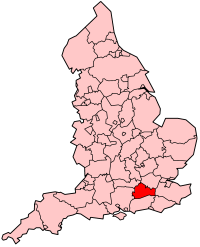
Surrey ( SUH-ree) is a ceremonial county in South East England. It is bordered by Greater London to the northeast, Kent to the east, East and West Sussex to the south, and Hampshire and Berkshire to the west. The largest settlement is Woking. The county has an area of 1,663 km2 (642 square miles) and had an estimated population of 1,248,649 in 2024. The north of the county, which includes the towns of Staines-upon-Thames and Epsom, is densely populated and forms part of the Greater London conurbation. A second conurbation along the western border of the county includes Camberley and Farnham and extends into Hampshire and Berkshire. Woking is located in the north-west, and Guildford in the centre-west. The south of the county is rural, and its largest settlements are Horley in the south-east and Godalming in the south-west.
Bell Homestead National Historic Site
Alexander Graham Bell made the world's first long-distance telephone call from his father's homestead in Tutela Heights, just minutes from West Brant. The Bell Homestead National Historic Site preserves the farmhouse and coach house where Bell conducted his early telephone experiments in the 1870s. Open seasonally for tours.
Timeline
Notable People
Photos



Full History
| End = | Replace = | image = Flag of Surrey in Guildford.jpg | image_caption = The flag of Surrey flown at the Guildford Guildhall, 2022 | Civic = | PopulationFirst = 452,218 | PopulationFirstYear = 1891 | PopulationLast = 1,002,832 | PopulationLastYear = 1971 }} The Local Government Act 1888 reorganised county-level local government throughout England and Wales. Accordingly, the administrative county of Surrey was formed in 1889 when the Provisional Surrey County Council first met, consisting of 19 aldermen and 57 councillors. The county council assumed the administrative responsibilities previously exercised by the county's justices in quarter sessions. The county had revised boundaries, with the north east of the historic county bordering the City of London becoming part of a new County of London. These areas now form the London Boroughs of Lambeth, Southwark and Wandsworth, and the Penge area of the London Borough of Bromley. At the same time, the borough of Croydon became a county borough, outside the jurisdiction of the county council. For purposes other than local government the administrative county of Surrey and county borough of Croydon continued to form a "county of Surrey" to which a Lord Lieutenant and Custos Rotulorum (chief magistrate) and a High Sheriff were appointed. Surrey had been administered from Newington since the 1790s, and the county council was initially based in the sessions house there. As Newington was included in the County of London, it lay outside the area administered by the council, and a site for a new county hall within the administrative county was sought. By 1890 six towns were being considered: Epsom, Guildford, Kingston, Redhill, Surbiton and Wimbledon. In 1891 it was decided to build the new County Hall at Kingston, and the building opened in 1893, but this site was also overtaken by the growing London conurbation, and by the 1930s most of the north of the county had been built over, becoming outer suburbs of London, although continuing to form part of Surrey administratively. In 1960 the report of the Herbert Commission recommended that much of north Surrey (including Kingston and Croydon) be included in a new "Greater London". These recommendations were enacted in highly modified form in 1965 by the London Government Act 1963. The areas that now form the London Boroughs of Croydon, Kingston, Merton, and Sutton and that part of Richmond south of the River Thames, were transferred from Surrey to Greater London. At the same time part of the county of Middlesex, which had been abolished by the legislation, was added to Surrey. This area now forms the borough of Spelthorne. Further local government reform under the Local Government Act 1972 took place in 1974. The 1972 Act abolished administrative counties and introduced non-metropolitan counties in their place. The boundaries of the non-metropolitan county of Surrey were similar to those of the administrative county with the exception of Gatwick Airport and some surrounding land which was transferred to West Sussex. It was originally proposed that the parishes of Horley and Charlwood would become part of West Sussex; however this met fierce local opposition and it was reversed by the Charlwood and Horley Act 1974.
Source: Wikipedia