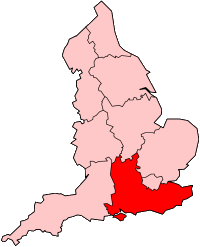
Sussex (/ˈsʌsɪks/; from the Old English: Sūþseaxe, lit. 'South Saxons') is an area of South East England that was historically a kingdom and, later, a county. The current ceremonial counties of East Sussex and West Sussex cover approximately the same area. The two ceremonial counties border Surrey to the north, Kent to the north-east, the English Channel to the south, and Hampshire to the west. Sussex contains the city of Brighton and Hove and its wider city region, part of the South Downs National Park and the national landscape of the High Weald, and Chichester Harbour. Its coastline is 137 miles (220 km) long. The Kingdom of Sussex emerged in the fifth century in the area that had previously been inhabited by the Regni tribe in the Romano-British period. In about 827, shortly after the Battle of Ellendun, Sussex was conquered by Wessex. From 860 it was ruled by the kings of Wessex, and in 927 it became part of the Kingdom of England.
Bell Homestead National Historic Site
Alexander Graham Bell made the world's first long-distance telephone call from his father's homestead in Tutela Heights, just minutes from West Brant. The Bell Homestead National Historic Site preserves the farmhouse and coach house where Bell conducted his early telephone experiments in the 1870s. Open seasonally for tours.
Timeline
Photos


Full History
Finds at Eartham Pit in Boxgrove show that the area has some of the earliest hominid remains in Europe, dating back some 500,000 years and known as Boxgrove Man or Homo heidelbergensis. At a site near Pulborough called The Beedings, tools have been found that date from around 35,000 years ago and that are thought to be from either the last Neanderthals in northern Europe or pioneer populations of modern humans. The thriving population lived by hunting game such as horses, bison, mammoths and woolly rhinoceros. Around 6000 BC, the ice sheet over the North Sea melted, sea levels rose and the meltwaters burst south and westwards, creating the English Channel and cutting the people of Sussex off from their Mesolithic kinsmen to the south. Later in the Neolithic period, the area of the South Downs above Worthing was one of Britain's largest and most important flint-mining centres. The flints were used to help fell trees for agriculture. The oldest of these mines, at Church Hill in Findon, has been carbon-dated to 4500 BC to 3750 BC, making it one of the earliest known mines in Britain. Flint tools from Cissbury have been found as far away as the eastern Mediterranean. Sussex is rich in remains from the Bronze and Iron Ages, in particular the Bronze Age barrows known as the Devil's Jumps and Cissbury Ring, one of Britain's largest hillforts. Towards the end of the Iron Age in 75 BC people from the Atrebates, one of the tribes of the Belgae, a mix of Celtic and German stock, invaded and occupied southern Britain. This was followed by an invasion by the Roman army under Julius Caesar that temporarily occupied south-eastern Britain in 55 BC. or southern Atrebates, a region which included most of Sussex, with their capital in the Selsey area. A number of archaeologists now think there is a strong possibility that the Roman invasion of Britain in AD 43 started around Fishbourne and Chichester Harbour rather than the traditional landing place of Richborough in Kent. According to this theory, the Romans were called to restore the refugee Verica, a king whose capital was in the Selsey and Chichester area, Much of Sussex was a Roman canton of the Regni, probably taking a similar area to the pre-Roman tribal area and kingdom. The foundation legend of Sussex is provided by the Anglo-Saxon Chronicle, which states that in the year AD 477 Ælle landed with his three sons. Having fought on the banks of the Mearcredesburna, it seems Ælle secured the area between the Ouse and Cuckmere in a treaty. Traditionally this is thought to have been against native Britons, but it may have been to secure the area east of the Saxon Shore fort of Anderida from the influence of the Kingdom of Kent, with whom the South Saxons may have had occasional disputes. Shortly afterwards, Cædwalla returned to Sussex, killing its king and oppressing its people, putting them in what Bede called "a worse state of slavery". The South Saxon clergy were put under the control of West Saxon Winchester. which later grew into the Kingdom of England. The Battle of Hastings was fought in Sussex, the victory that led to the Norman conquest of England. In September 1066, William of Normandy landed with his forces at Pevensey and erected a wooden castle at Hastings, from which they raided the surrounding area. The battle was fought between Duke William of Normandy and the English king, Harold Godwinson, who had strong connections with Sussex and whose chief seat was probably in Bosham. After having marched his exhausted army from Yorkshire, Harold fought the Normans at the Battle of Hastings, where England's army was defeated and Harold was killed. It is likely that all the fighting men of Sussex were at the battle, as the county's thegns were decimated and any that survived had their lands confiscated. William built Battle Abbey at the site of the battle, with the exact spot where Harold fell marked by the high altar. In the immediate aftermath of the Normans' landing at Pevensey and the Battle of Hastings and to put an end to any rebellion, the Norman army destroyed estates and other assets on their route through Sussex, leading to a 40 per cent reduction in Sussex's wealth, a situation worse than any other southern or midland county. By 1086 wealth in Sussex was still 10 to 25 per cent lower than it had been in 1066. It was also during the Norman period that Sussex achieved its greatest importance in comparison with other English counties. Sussex was on the main route between England and Normandy, and the lands of the Anglo-Norman nobility in what is now western France. The growth in Sussex's population, the importance of its ports and the increased colonisation of the Weald were all part of changes as significant to Sussex as those brought by the neolithic period, by the Romans and the Saxons. The Normans also built Chichester Cathedral and moved the seat of Sussex's bishopric from Selsey to Chichester. The Normans also founded new towns in Sussex, including New Shoreham (the centre of modern Shoreham-by-Sea), Battle, Arundel, Uckfield and Winchelsea. During the Hundred Years' War, Sussex found itself on the frontline, convenient both for intended invasions and retaliatory expeditions by licensed French pirates. Hastings, Rye and Winchelsea were all burnt during this period was the perceived injustice that led many Sussex people to participate in the Peasants' Revolt of 1381. Coastal areas suffered most from the Black Death, and took longest to recover. Instead much economic activity in Sussex was focused on the Weald. Merchants moved north from the coastal towns and many Continental craftsmen, fleeing religious persecution, brought their expertise to the timber, iron, clothmaking and glass industries. Economic and social tensions continued for many years as Sussex people were also involved in Jack Cade's rebellion of 1450, in which Cade may have been killed at Cade Street, near Heathfield. Demands grew more radical in Sussex in 1451 when John and William Merfold advocated rule by common people. They also demanded that Henry VI be deposed and publicly incited the killing of the nobility and clergy. The Wealden iron industry expanded rapidly, especially after the first blast furnace arrived in Sussex in 1496, from the Low Countries, which greatly improved efficiency. Skilled Flemish workers moved to Sussex, followed later by Huguenot craftsmen from France, who brought new techniques. The industry was strategically important and flourished into the 17th century, after which it began to decline. It also brought widespread deforestation of parts of the Sussex Weald. Henry VIII's separation of the Church of England from Rome and the dissolution of the monasteries led to the demolition of Lewes Priory and Battle Abbey and the sites being given to Henry's supporters. The shrine to St Richard at Chichester Cathedral was also destroyed. Mary I returned England to Catholicism and in Sussex 41 Protestants were burned to death. Under Elizabeth I, religious intolerance continued albeit on a lesser scale, with several people being executed for their Catholic beliefs. Shortly after there were sieges at Chichester and Arundel, and a smaller battle at Bramber Bridge. Despite its being under Parliamentarian control, Charles II was able to journey through the county after the Battle of Worcester in 1651 to make his escape to France from the port of Shoreham. In 1681 Charles II granted William Penn lands in what became Pennsylvania and Delaware. Amongst those whom he carried to North America as colonists were 200 people from Sussex, mostly Quakers, who founded settlements named after places in Sussex including Lewes and Seaford in Sussex County, Delaware and Horsham Township and Chichester in Pennsylvania. The Sussex coast was greatly modified by the social movement of sea bathing for health which became fashionable among the wealthy in the second half of the 18th century.
Source: Wikipedia